|
1
|
|
|
2
|
- K8RRH & I purchased new Drake R-4Cs in the late 70s
- Used them during the ARRL 160m CW contest
- Radios performed miserably yet Specs Were Good
- 70s: League expanded testing to include Noise Floor & Dynamic Range,
new concepts for the amateur.
- R-4C tested well for Dynamic Range, but flunked CW contest 101
- Was the wrong thing being tested or did the test not approximate a real
amateur environment, especially
a CW contest environment?
|
|
3
|
- 20 kHz Dynamic Range test showed that in a multi-conversion radio it was
only testing the radio’s front end
- If the first IF was 6 - 20 kHz wide, be it at 5 MHz, 9 MHz
or 45 - 70 MHz, the radio would overload in a pile up.
- 20 kHz test showed no hint of the problem
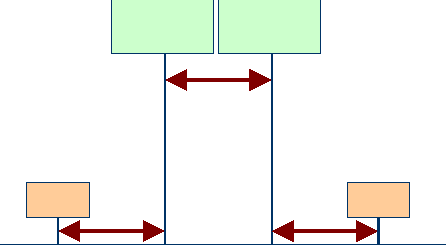
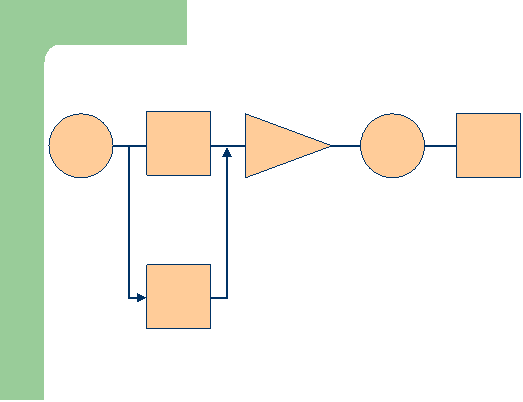
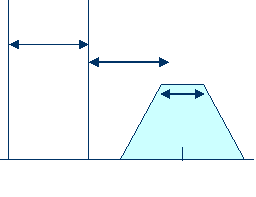
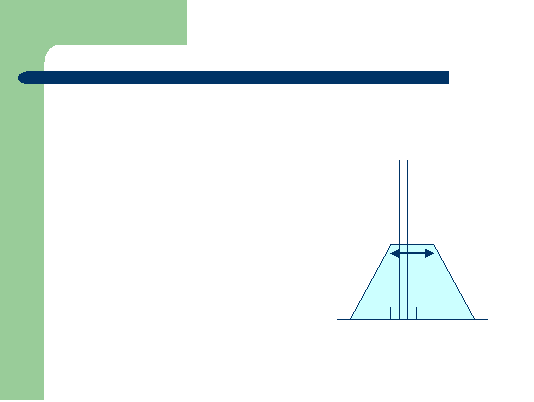
- Solution: Place test signals close together so they pass through 1st IF
Filter " the Next
Amplifier "
Mixer
- Close-in dynamic range numbers were ALWAYS drastically worse than the
wide-spaced numbers & correctly approximated a CW pileup
|
|
4
|
- Noise Floor
- Close-in Dynamic Range
|
|
5
|
- Sensitivity is a familiar number, normally applies to SSB.
- Sensitivity = 10 dB Signal + Noise / Noise (10 dB S+N/N)
- Noise Floor = 3 dB Signal + Noise / Noise (3 dB S+N/N)
- Noise floor can be measured at any filter bandwidth, CW or SSB, for
example
- League normally only publishes noise floor for a CW bandwidth, typically
500 Hz CW filter
|
|
6
|
- What is the Close-in Dynamic Range vs Wide-Spaced Dynamic Range
published in QST?
- (Note: recent expanded League receiver tests include close-in Dynamic
Range, somewhat buried in a graph)
- Why is Close-in Dynamic so important?
|
|
7
|
|
|
8
|
|
|
9
|
|
|
10
|
|
|
11
|
|
|
12
|
|
|
13
|
|
|
14
|
|
|
15
|
- Ten-Tec Orion & Icom IC-7800
- Until the Orion came out, 99% of modern transceivers were up conversion
radios. (K2 the exception)
- If the first IF is above 10 meters (30 MHz), can you switch in a narrow
CW roofing filter? No
- The fractional bandwidth of a 600 Hz CW filter at 5 MHz is the same as a
6 kHz filter at 50 MHz.
- Thus most up conversion radios have a first IF at least 6 kHz wide &
often as wide as 15 kHz.
|
|
16
|
- 20 kHz for FM
- 6 kHz for AM or wide Hi Fi SSB
- 2.4 kHz for most SSB operation
- 1.0 kHz for most CW operation
- One can add optional roofing filters of 1.8 kHz,
500 Hz & 250 Hz bandwidths
|
|
17
|
- Roofing Filters track DSP Bandwidth Setting
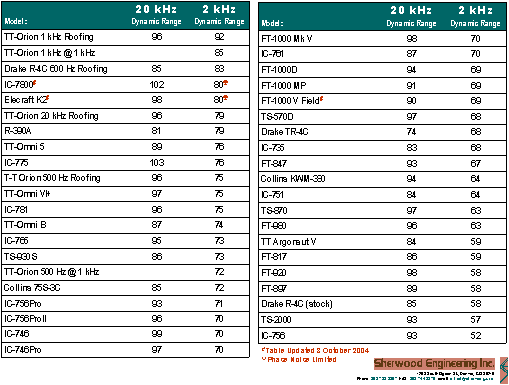
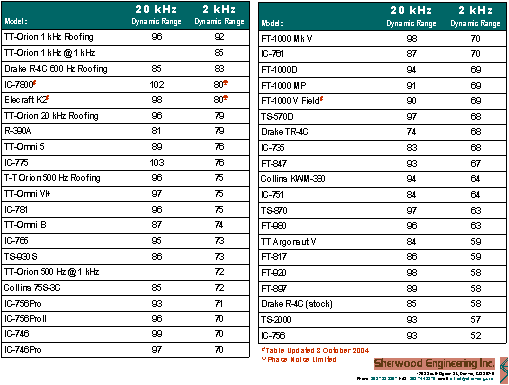
- Dynamic range of the Orion with various Roofing Filters (Refer to Rig
Table)
- Discuss Proposed Changes to Orion Design
- Bank of 7 Filters. Ignore Insertion Loss
- The Orion offers lots of features, but some quirks that some operators
may find objectionable
- This discussion revolves around close-in dynamic range only & the
Orion’s absolutely excellent final DSP filtering down to as narrow as
150 Hz bandwidth
|
|
18
|
|
|
19
|
- The often-quoted specification of a third order intercept (IP3) in
excess of +40 dBm is intriguing.
- Few Published Specifications, other than IP3
- I have not tested the 7800
- All data from the League
- Wide-spaced data < Measurements from Icom Factory
|
|
20
|
- Phase noise & IMD have similar magnitude at 1 & 2 kHz spacing.
- Dynamic Range > Wide-Spacing due to Tracking Preselector
- One would expect a dynamic range closer to 110 dB with an IP3 greater
than +40 dBm.
|
|
21
|
- Narrow Roofing Filters concept proved effective in late 70s with a niche
after market product. It has finally been incorporated into a modern
solid-state transceiver.
- The unknown question is whether the over all experience provided by the
Orion will grab enough market share to awaken the Japanese OEMs to offer
this level performance.
- Orion offers 10 - 15 dB improvement & in many cases up to 20 – 30 dB
in handling close-in strong undesired signals, compared to others.
|
|
22
|
- Need Improvement
- ALC induced splatter on SSB
- Key clicks on CW
- ALC / Processor Affecting Rise & Fall Time
|
|
23
|
- Contester needs best receiver possible, especially for CW operation
- Ten-Tec Orion design is a step in a new direction. It has taken over 25
years for my concept of using roofing filters with a bandwidth similar
to the final selectivity to be incorporated into an OEM rig.
- 25 years of up conversion radios have generally offered a 20 kHz dynamic
range in the 90s but a 2 kHz close-in dynamic range in the 70s. Typical
degradation of dynamic range within the up conversion filter bandwidth
is 25 dB.
|
|
24
|
- The key question has been whether it would be possible to design an up
conversion radio with the capability to maintain most of the dynamic
range provided by the front end (first mixer). Preliminary numbers on
the 7800 continue to show the normal degradation inside the first IF
roofing filter of more than 20 dB.
- If, however, one could produce a 20 kHz dynamic range of 110 dB and a 2
kHz dynamic range of 90 dB, this would be adequate in most cases. So far this “dream” has been elusive.
|
|
25
|
|

 Notes
Notes